Sustainability / EUDR
What does the EUDR mean for your coffee?
The European Deforestation Regulation requires insight into where coffee comes from.
What is the EUDR?
Europe is setting new requirements for coffee. Under the EU Deforestation Regulation (EUDR, Regulation (EU) 2023/1115), it must be demonstrable that coffee does not contribute to deforestation, and exactly where it was grown.
The regulation covers seven commodities that play a major role in deforestation: coffee, cocoa, palm oil, soy, rubber, wood and cattle.
What is required:
- Deforestation-free: the coffee must not be grown on land deforested after 31 December 2020.
- Legally produced: in line with the laws of the country of origin.
- Exact origin: the location of the plots where the coffee was grown must be known.
- Due diligence statement: whoever places the coffee on the European market records this in a statement.
When? The rules apply from 30 December 2026 for large and medium-sized companies, and from 30 June 2027 for micro and small companies.
The regulation requires demonstrably deforestation-free coffee and reliable origin information.
A clear origin. A transparent chain.
Robert, our CEO, is staying in Kenya to create a new coffee label. With attention to transparent origin and the European requirements for the coffee chain.
Robert is already preparing the new coffee for this: with information on the growing locations, the parties involved and the documentation that goes with it. The coffee and its substantiation are still in development.
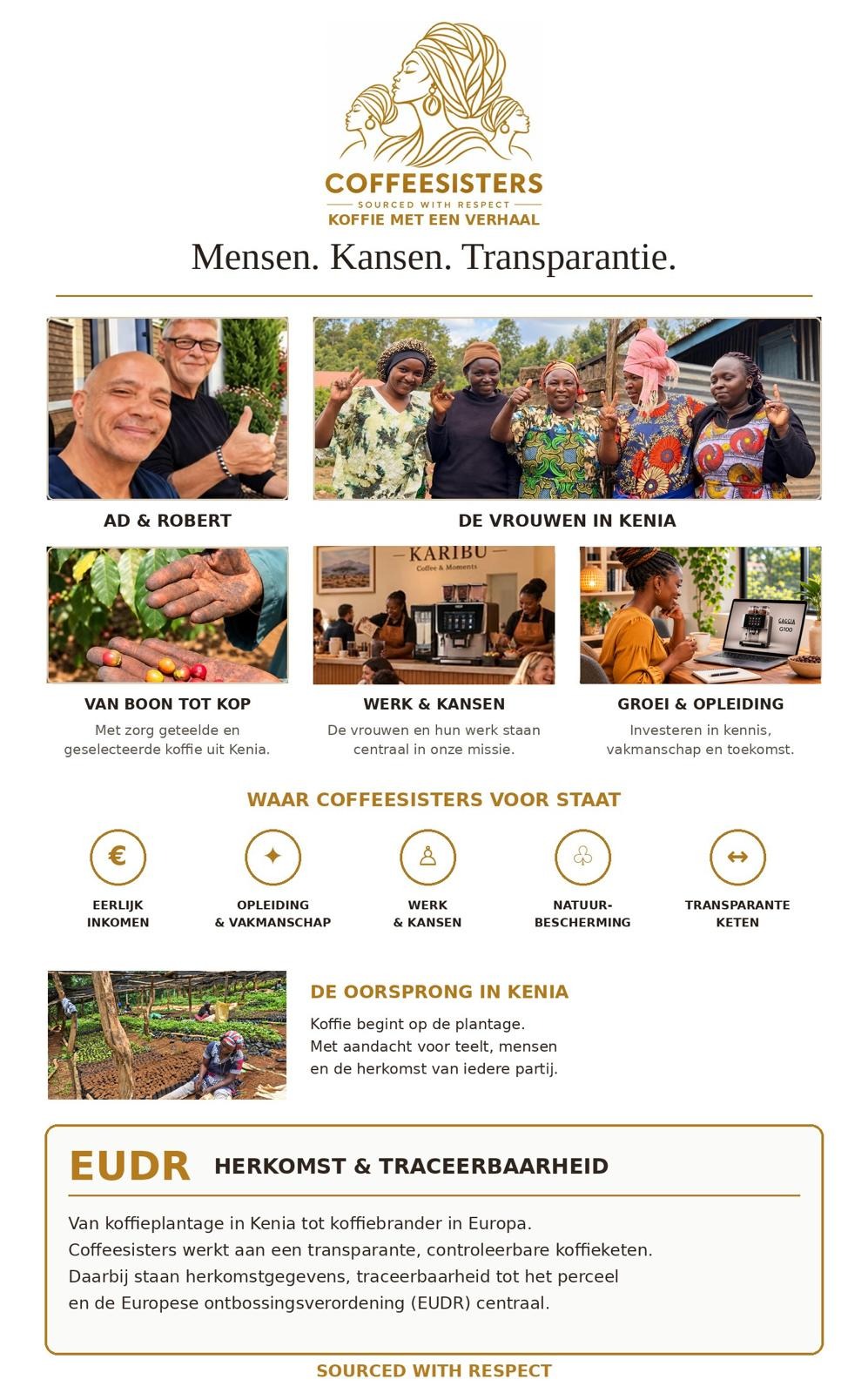
Coffeesisters
His goal is to bring high-quality green coffee directly from the origin to coffee roasters, with a transparent origin and in line with the requirements of the European deforestation regulation (EUDR).
Through their coffee roaster, companies can choose Coffeesisters coffee. They may then use the Coffeesisters coffee label and receive a communication toolkit to tell the story behind their coffee.